Eastern wisdom
What Is the Tao Te Ching?
A 2,500-year-old Chinese text about how to live in harmony with the natural flow of things. Short, strange, and quietly radical.
The Tao Te Ching (also spelled Dao De Jing) is a 2,500-year-old Chinese text attributed to a figure named Laozi — literally "Old Master." It's short: 81 brief verses, most under a page. And it's foundational: the source text of Taoism, one of the three great philosophical traditions of China alongside Confucianism and Buddhism.
You could read the whole book in an afternoon. People have spent lifetimes trying to understand it.
What it's about
The Tao Te Ching is about how to live in harmony with the Tao — usually translated as "the Way" or "the natural flow of things." It's not a religious text in the modern sense. There's no god, no doctrine. It's a book of paradoxes and observations about how life actually works.
Its central ideas include:
- Wu wei (无为) — often translated as "effortless action" or "not-forcing." The idea that the most effective way of moving through the world is not to strain against it but to move with its grain.
- The value of the empty — a cup is useful because it's empty; a room is useful because it's not full. The unspoken and the unfilled are as important as the said and the done.
- Softness overcoming hardness — water wears down stone. The Tao Te Ching returns to this metaphor again and again.
- Simplicity as a discipline — reducing rather than adding is often the wiser move.
Who wrote it
Traditionally attributed to Laozi, a 6th-century BCE philosopher said to have been an archivist for the Zhou court. Modern scholarship treats this attribution as legendary — the text was likely compiled over several centuries and may represent a school of thought rather than a single author.
That mystery around authorship is somehow fitting for a book that's suspicious of names, categories, and definitions.
Why it still matters
The Tao Te Ching keeps finding new audiences because its observations are remarkably durable. Its ideas about non-forcing, humility, and moving with change map cleanly onto modern conversations about burnout, productivity, and the limits of will.
It's also short enough to read many times. Most people who love the Tao Te Ching don't read it linearly — they open to a random verse and sit with it.
Reading it today
There are dozens of English translations. A few widely-loved ones:
- Stephen Mitchell — the poetic, modern-English classic. A great first read.
- Ursula K. Le Guin — a novelist's version, warm and accessible.
- D.C. Lau — more scholarly, closer to the literal Chinese.
- Red Pine (Bill Porter) — includes traditional commentaries alongside the text.
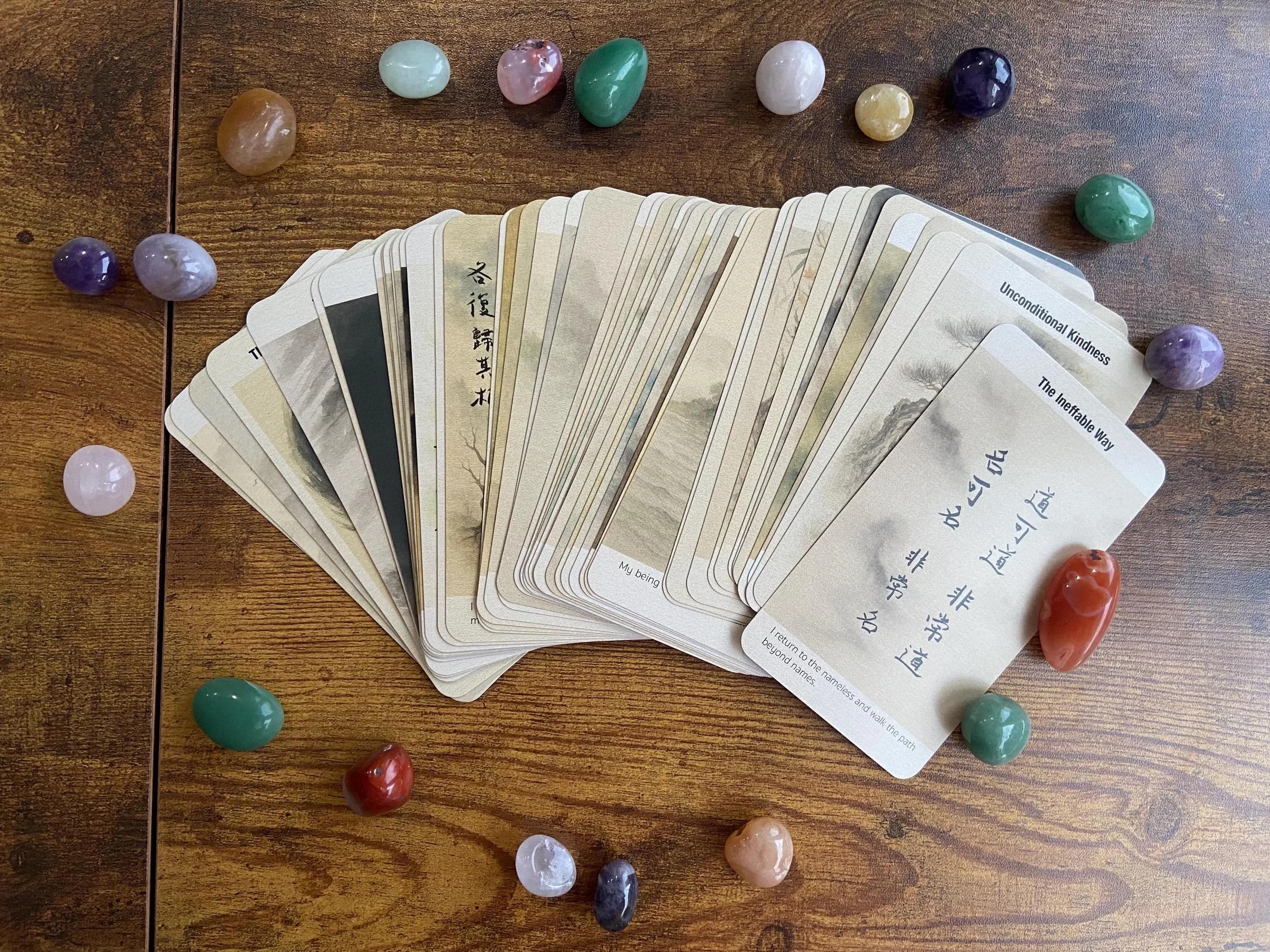
If you want to sit with one verse a day as a practice, our Tao Oracle Cards draw from the Tao Te Ching's 49 most-quoted verses and reframe each as a modern reflection paired with a visual contemplation.